Brothers survived liberation
Berek, Chaim Dawid, Majer and Henry survived to liberation; the family record gives Chaim’s death year as 1945.
Działoszyce · Poland · the world beyond
A living record of one family—its homes, names, documents, losses and survival—assembled so that each generation can know where it began.
Join the family archive
Register your name, email and relationship to someone in the archive. This is a family-directory registration, not password-based identity verification.
Your details are stored privately for archive administration and are not displayed publicly.
The record so far
The archive reaches eight named generations, from Majer Jurysta, born about 1783, to today’s generation—Eliana, Samuel and Elyse. The continuous document-supported line now runs from Majer and his first wife Rywka through their son Lewek and Marya Moszkowicz; Abram “Sandel Abram” and Chana Rywka Pilarz; Majer and Tauba; Judka and Bluma; Symcha and Szajndla; and their descendants. The Abram born in 1838 to Majer and Fajgla was a different child in Majer’s probable later household.
Origins, growth and rupture
The earliest proved direct-line household is Majer Jurysta and his first wife Rywka. Their son Lewek’s 1829 marriage to Marya Moszkowicz, Abram’s 1830 birth, Abram and Ryfka Pilarz’s 1852 marriage, and their son Majer’s 1852 birth form a linked chain into the later civil acts. Majer’s probable later household with Fajgla belongs beside that direct line as a collateral half-sibling household, not as the ancestry of Abram “Sandel Abram.”
By the late nineteenth century the surname had spread through multiple Działoszyce households and marriage networks reaching Nowy Korczyn, Busk, Żarki, Kromołów, Częstochowa, Chmielnik, Książ Wielki and Sosnowiec. Several sibling households were raising children in the late 1920s and early 1930s. The surviving registers do not yet establish a numerical peak for the whole family.
German occupation turned that demographic peak into catastrophe. Symcha was killed in the first days of September 1939; the 1942 liquidation destroyed the Jewish community and carried away most of the remaining family. A small survivor cluster rebuilt in displaced-person camps, New York, Florida and Israel. The postwar family is therefore both a continuation and a record of an interrupted community.
Berek, Chaim Dawid, Majer and Henry survived to liberation; the family record gives Chaim’s death year as 1945.
Berek, Majer and Henry appear on the January 1950 New York arrival manifest.
Including the Shaya, Arye and Sam branches. Not a complete emigrant census; no speculative upper total.
For every generation
Choose a reader’s age and a chapter of the family history. Younger readers receive a gentle account centered on family, courage and remembrance. Older readers receive progressively fuller historical context about persecution, forced labor and loss.
The generator never changes the underlying facts. It adjusts vocabulary and the explicitness of difficult Holocaust history. It does not invent dialogue, private thoughts or undocumented events.
Created from the Jurysta Archive’s documented facts and clearly labeled family testimony. This is an educational retelling, not a primary source. Review the archive’s evidence labels and original documents for research use.
Family tree
Green cards are supported by civil or contemporary records. Amber cards preserve family testimony and strong working hypotheses without presenting them as proved.
Open the compact all-branches treeRead the full reconciled family treeSearch all indexed records and scans
The linked civil acts establish Majer and Rywka → Lewek and Marya Moszkowicz → Abram “Sandel Abram” and Chana Rywka Pilarz → Majer and Tauba née Sziewicz → Judka and Bluma née Swicarczyk. The later Symcha household is strongly linked, but birth Act 78’s female wording remains unresolved. Sandel provides the resolved bridge to Arye and Shaya. Samuel’s separate record names Josef as his father and connects him to Rutka’s household; Shmuel’s different record has incorrect parents and his branch remains unresolved. The Częstochowa bridge remains provisional.
Majer born c.1782–83 · Rywka died before May 1829
Lewek’s 1829 marriage act names Majer and deceased Rywka as his parents. Majer was present, consented and signed; his age as an 1830 witness aligns with the same early family head.
married 21 May 1829 · Działoszyce Act 4
Lewek, about 25, was the son of Majer and deceased Rywka. Marya, about 23, was the daughter of deceased Zanel Moszkowicz and Mindla.
Majer’s probable later household with Fajgla produced Mortka (1836), Abram (1838) and Wolf (1842). That 1838 Abram is distinct from Lewek and Marya’s Abram born in 1830.
Collateral Działoszyce branch
both born c.1809 · married 1833, Act 14
Ryfka’s parents: Berek Majerczyk and Rykla.
both c.1840 · married 10 Aug 1858, Act 20
Ruda’s parents: Icek and Laja Cukierman.
Majer born 15 Jul 1864 · married 24 Apr 1883, Act 21
Małka’s parents: Szmul and Chaja Pilcer.
born 4 Mar 1898, Działoszyce
Later Kraków records appear to understate his age by four years.
Direct ancestral line
Abram born 11 Aug 1830 · married Ryfka Pilarz in 1852
Abram’s birth names Lewek and Marya as his parents. His 1852 marriage to Ryfka Pilarz and their son Majer’s 1852 birth connect directly to the compound name Sandel Abram in Majer’s 1873 marriage act.
married 16/28 Feb 1873 · Act 7
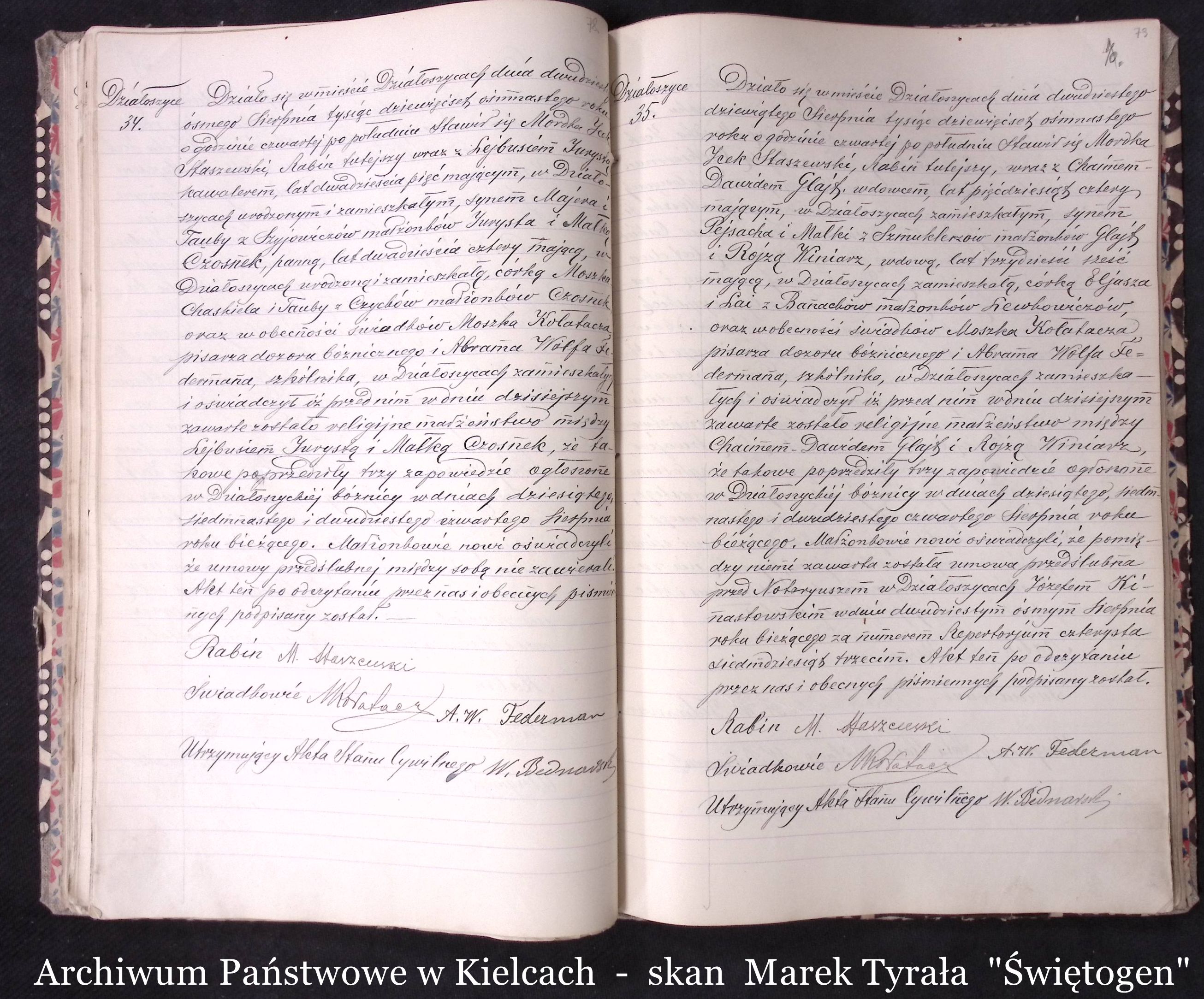
Children established by reviewed acts and registers include Judka, Ajdla, Zajnwel, Szajndla, Laja and Lejbuś. Sendel’s and Sura’s later links are separately indexed. Lejbuś’s 1918 marriage Act 34 explicitly names Majer and Tauba as his parents.
Judka born 1/13 Apr 1874 · married 25 Mar/6 Apr 1894, Act 11
Judka’s birth and marriage records identify Majer and Tauba as his parents. Symcha’s Act 78 identifies Judka and Bluma/Blima née Swicarczyk as his parents. Brandla/Brajndla, born 30 September 1915, is confirmed by late-registration Act 208/1923.
Symcha born 2 Apr 1895 · Szajndla born 2 Dec 1892, Nowy Korczyn
The household is documented; identifying its male Symcha with Act 78 is strongly supported despite that act’s female wording. Szajndla appears in Nowy Korczyn birth Act 82 with Laja; the original act still needs to be paired to the index.
born 3 May 1917
Birth Act 217/1919 confirms 3 May 1917 and parents Symcha and Szajndla. First married Ruchla Gitla; later Manci / Munci Jacobs Jurysta. Children: Deborah and Loretta.
12 Aug 1918–1945 · Act 218/1919
Act 218 names Symcha and Szajndla and gives a birth date in the previous year, 1918. Family evidence places him through liberation; the family record gives his death year as 1945. Act 149/1921 belongs to Sandel’s son, a different child.
15 Sep 1922–19 Apr 2000 · Act 209/1923
Act 209 confirms Symcha and Szajndla née Fisz and states that Majer was born 15 September of the previous year—1922. Married Rose Mermelstein in New York, 1956. Children: Steven, Barbara, Alan and Ilissa. Alan’s children: Eliana, Samuel and Elyse.
1924/1925–1999
Later birth date 10 May 1925 conflicts with household date 2 July 1924. Hanandel and Heniek/Henryk are the same son of Symcha and Szajndla. His exact civil birth entry remains to be recovered.
This established collateral descendant line also runs through Judka and Bluma, independently of their son Symcha’s household above.
Confirmed Israel descendant branch
Sandel born 4 Apr 1898 · son of Judka and Bluma
Population-register and family evidence establish Sandel as a child of Judka and Bluma and as the father, with Bajla Rywka née Lewandowska, of Shaya and Arye.
born 25 Feb 1928 · emigrated to Israel
Family evidence identifies him as Shaya’s brother and Rachel’s husband. Children: Yaron, Jody and Dudi Yurista. Their parents are Sandel Jurysta—documented as a child of Judka and Bluma—and Bajla Rywka née Lewandowska.
born c.1925 · emigrated to Israel
Family and archival evidence identify him as Arye’s brother and as a son of Sandel Jurysta and Bajla Rywka née Lewandowska, linking this branch through Sandel to Judka and Bluma.
Confirmed Tosia descendant branch
Lejbuś born 27 May/8 Jun 1893 · married 28 Aug 1918, Act 34
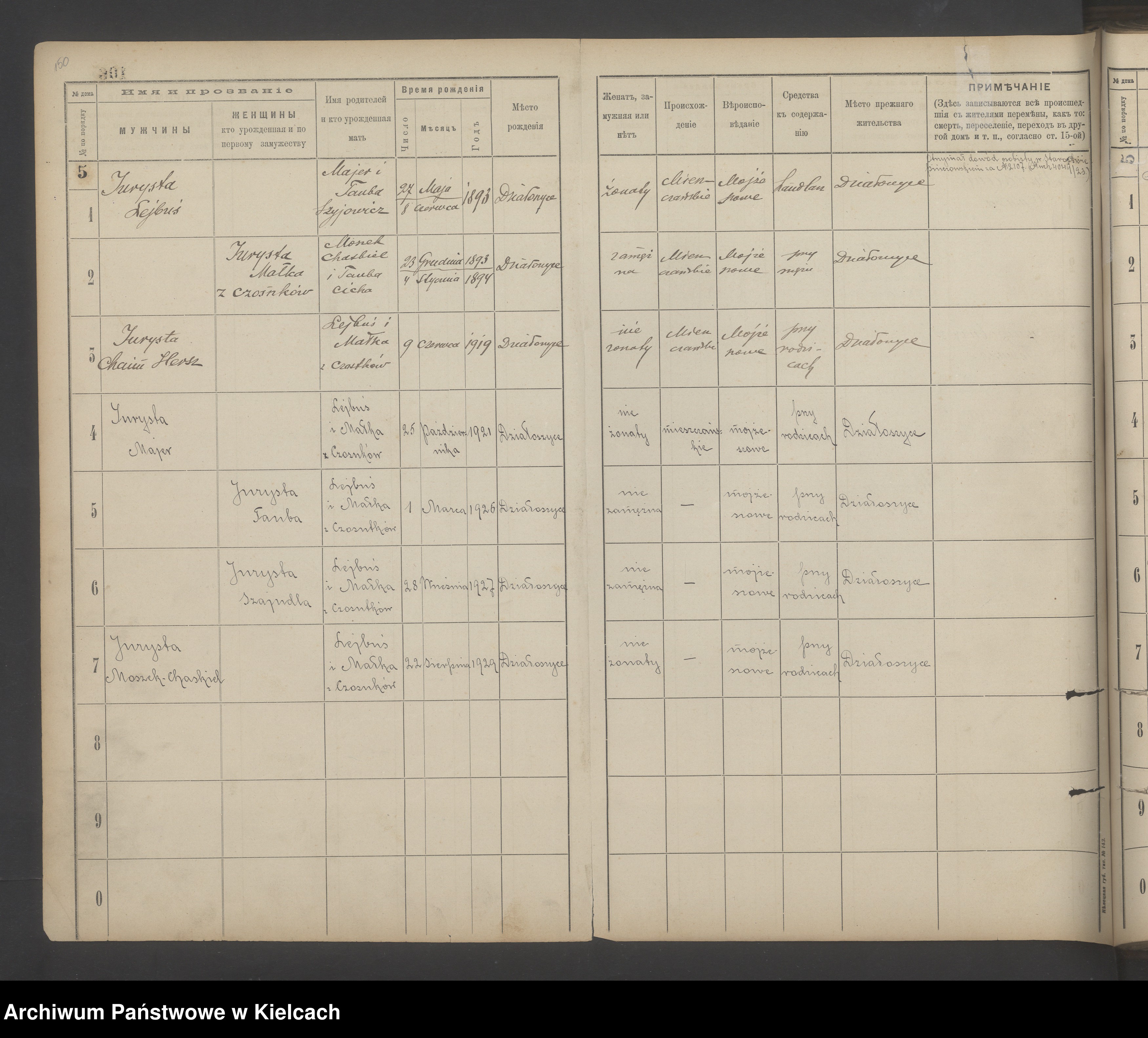
Marriage Act 34 names Lejbuś as a son of Majer Jurysta and Tauba née Szyjowicz. The household register lists Lejbuś and Małka’s children, including Samba, born 1 March 1926.
born 1 Mar 1926 · Działoszyce · survived
Tosia’s archival birth date and birthplace match the child Samba in Lejbuś and Małka’s household register. Together with the parental names Lejb/Lejbuś and Małka, the records resolve her placement as their daughter and Majer and Tauba’s granddaughter.
Reconciled Kraków survivor branch
separate survivor record · parental branch unresolved
This record contains incorrect parent information and is not Samuel’s Josef-parent record. It does not establish Sanel/Sandel Jurysta and Malka Munz as Shmuel’s parents.
The central Jurysta line is joined to the Jacobs/Jakab survivor family through Berek and Manci, and to the Mermelstein–Lichtman family through Meyer and Rose. Earlier marriages add the Szyewicz, Swicarczyk, Fisz, Lewandowska, Majerczyk, Cukierman and Pilcer families. Click any underlined name for an individual report.
Jurysta · Działoszyce
Działoszyce and Nowy Korczyn
Parents of the documented prewar household.
1917–1999
Married Ruchla Gitla; later Manci / Munci Jacobs Jurysta.
1922–2000
Civil Act 209/1923 says born in the previous year. Married Rose Mermelstein in 1956.
1924/1925–1999
Later birth date 10 May 1925 conflicts with household date 2 July 1924. Hanandel and Henry are the same person; the exact civil act remains to be recovered.
12 Aug 1918–1945 · Act 218/1919
Birth act and parentage recovered; family record gives his death year as 1945.
Jacobs / Jakab · Romania and Szatmár region
mother of Manci/Maria, Lilly/Elena, Alice/Bella, Gene, Harold and Bill
Her husband and original Hungarian name remain unknown.
Maria Jacobs · 1921–1995 · Auschwitz survivor
Family-confirmed life dates are 1921–1995. Her petition uses Maria Jacobs, also known as Mance Jacobs, but contains a conflicting typed birth date. She arrived on the Marine Flasher in 1946 and later married Berek Jurysta; daughters Deborah and Loretta.
formerly Elena Jacobs · born 12 Oct 1919 · Auschwitz survivor
Arrived with Maria and Bella in 1946; married Bela Szender. Children: Gloria and Rita.
Bella Jacobs · born 16 Dec 1924
Her declaration records Bella Jacobs, also known as Alice Jacobs, born in Garbo, Romania; she arrived with her sisters in 1946.
Manci’s sibling
Additional details have not yet been supplied.
Manci’s sibling
Additional details have not yet been supplied.
Manci’s sibling
Additional details have not yet been supplied.
born 27 Feb 1948
Daughter of Lilly and Bela Szender.
born 25 Jun 1952
Daughter of Lilly and Bela Szender.
Mermelstein · Beregszász and New York
Michael 1867–1943 · Roza c.1862–1927 · immigrated in 1900
Death certificates name Michael’s parents as Jacob Mermelstein and Hannah Solomon, and Roza’s parents as Salomon Einzig and Rose Einzig. Their Hungarian marriage act is still sought.
born 1 Dec 1891 · married Isidor Gross in 1914
Children: Stanley, Adele, Jesse and Samson. Adele’s daughter Sheri later married Alan Levine.
born 5 Sep 1895 · married John Flicker in 1916
Children: Stanley (1916) and Stella (1918).
Isidore born 1 Sep 1900 · married 16 Jun 1927
Bessie was born Basche Lechtman on 7 Feb 1903 in Zwanata, Russia. Parents of Perry and Rose. Isidore supplied the information on Michael’s 1943 death certificate.
c.1883–17 Oct 1909
A New York death record confirms Jacob as a son of Michael Mermelstein and Rose Einzig; the 1900 manifest identification as Jeno/Jacob remains the most likely reading.
born 1897 · Beregszász
Indexed daughter of Mihály Mermelstein and Riza Egyes; later identity unresolved.
born 4 Jun 1928
Rose’s brother; changed the surname from Mermelstein to Morell.
21 Apr 1932–2019 · married Meyer Jurysta in 1956
Children Steven, Barbara, Alan and Ilissa.
Fisz · Nowy Korczyn
The index associates both names with birth Act 82/1892. The original act still requires a clean reading before Laja can be attached as Szajndla’s twin or sibling. Rywka Fisz, Act 39/1898, remains a likely sibling candidate rather than a proved sister.
Lewandowska branch
Born in 1919 (February/December readings unresolved) to Sandel Jurysta and Bajla Rywka Lewandowska; Berek’s first wife. Her pregnancy and wartime fate remain under investigation.
Swicarczyk / Świerczarska
Her 1894 marriage to Judka is documented. The parental household links the Jurysta line to another Działoszyce family.
Szyewicz · Działoszyce
The Majer–Tauba marriage act identifies her parental household and joins the Szyewicz family to the confirmed direct line.
Majerczyk · Cukierman · Pilcer
Ryfka Majerczyk, Ruda Cukierman and Małka Pilcer connect the documented Zajnwel–Izrael Lewek–Majer collateral branch to three additional Działoszyce families.
Survivor cousin lines
Samuel’s record names Josef as his father and links him to Rutka’s household. Shmuel appears on a separate record with incorrect parent fields, so his parental branch is unresolved. Brothers Arye and Shaya remain documented sons of Sandel and Bajla; Arye’s known children are Yaron, Jody and Dudi.
Generations in America
These recent family details were supplied by family members and have not yet been independently matched to civil records.
Descendants of Meyer Jurysta & Rose Mermelstein
married Geri Greenspan · 1992
Children: Joshua and Sarah.
Recent-generation family branch
Son: David Charles Jordan (born 17 Mar 1996).
married Fiona Campbell · 1996
Children: Eliana (12 Feb 2000), Sam (20 Mar 2003), and Elyse (5 Nov 2005).
married Steve Cerbone · 2000
Children: Matthew and Daniel.
Descendants of Berek Jurysta & Manci / Munci Jacobs Jurysta
married Gary Rosen · 1987
Children: Jared, Jamie, and Jaclyn.
Children: Blake Reino (Dec 2000), Chance Jurysta (Aug 2002), Ashton Reino (Apr 2004), and Parker Reino (Dec 2006).
Linked evidence
These links connect the Mermelstein, Lichtman and Jurysta branches to the original records. A record attached to a probable identity is labeled as such.
Działoszyce · 1867–1900
Działoszyce · 1836–1842
Działoszyce and Nowy Korczyn
Beregszász → New York
Romania → Bremerhaven → New York
Zwanata, Russia → New York
New York cemetery photographs
DP Germany → New York and Florida
Ancestry as evidence
The purpose is not to win every argument. It is to recognize what was said, decide whether engagement is safe and useful, and answer with a documented human story when that can make a difference.
See the family’s countries and townsAsk for the statement in plain language. Is it a stereotype, conspiracy theory, slur, Holocaust distortion, or a claim about all Jews based on one person or event?
Online harassment, threats and bad-faith provocation do not require debate. Preserve evidence, leave, block or report when safety matters more than engagement.
Bring forward a person, not an abstraction: a Działoszyce birth act, Lilly’s testimony, Bessie’s manifest, or the four brothers’ postwar records.
Try: “What evidence would change your mind?” “Would you say that about someone you knew personally?” or “Can I show you what that idea meant for my family?”
A concise response can be enough: “That claim is antisemitic and false. My family’s records show where this kind of dehumanization leads. I will discuss evidence, but not tolerate slurs.”
Correct the record for bystanders, link to a primary source, check on anyone targeted, and document or report incidents through the appropriate school, workplace or platform process.
Ask how the post-1945 displaced-person system treated displacement as an individual, often temporary status, while the UNRWA framework registers Palestine refugees and eligible descendants. What historical and legal choices produced that difference—and how can it be discussed without erasing either Jewish displacement after the Holocaust or Palestinian displacement beginning in 1948?
Document center
Original scans and translations are paired wherever possible. Every item opens in a new tab.
Translations and transcriptions on this site were prepared with ChatGPT and may contain errors, especially in handwritten names, dates, occupations and place names. Always compare the working translation with the original image and consult a qualified translator before relying on it for legal or genealogical proof.
Current research edition
The newly connected Majer–Rywka → Lewek–Marya → Abram/Sandel Abram line, with sources and remaining boundaries.
22 September 2026Originals, readings and unresolved questions
23 rechecked acts, corrected family links and a searchable catalog of every current index row.
Current audited editionOriginal scans · English research summaries
Marriages, deaths and newly documented family connections recovered from the civil registers and paired to the master index in September 2026.
1867–1900Eight civil acts · originals
Newly reconciled Działoszyce acts document three early households: Majer–Faygla, Lewek–Marya, and Zajnwel–Rywka. Individual scans are linked in the family-record shelf.
1836–1842Civil act · direct line
Names Lewek’s parents as Majer and deceased Rywka and records Majer’s presence and consent.
1829 · Act 4Civil act · direct line
Names Lewek Jurysta and Marya as Abram’s parents; Majer Jurysta appears as a witness.
1830 · Act 50Civil act · direct line
Repeats Abram’s parents as Lewek and Marya and identifies Ryfka’s Pilarz household.
1852 · Act 5Civil act · direct line
Names Abram Jurysta and Chana Ryfka née Pilarz as Majer’s parents.
1852 · Act 130Civil act · original
Names Majer’s parents as Sandel Abram and Rywka Chana, and Tauba’s as Lejbuś and Frymta née Dawidowicz.
1873 · Act 7Civil act · confirmed collateral line
Names Lejbuś as a son of Majer Jurysta and Tauba née Szyjowicz and Małka as a daughter of Moszek Chaskiel Czosnek and Tauba née Cych/Cicha (reading provisional).
1918 · Act 34Household register · family linkage
Lists their children, including Samba born 1 March 1926—the same date and place recorded for Tosia/Toshka in postwar files.
Prewar population registerCivil act · direct line
Names Judka’s parents as Majer and Tauba née Szyewicz and identifies Bluma’s parental household.
1894 · Act 11Original scan
Names Judka Jurysta and Bluma/Blima née Swicarczyk as Symcha’s parents, supporting the household link; the act’s female wording remains an explicit discrepancy.
1895 · Act 78English translation
Corrected research reading paired with Act 78; earlier crop showed the wrong act.
1895Population register · original
Records Berek’s birth date, Działoszyce birthplace, and parents Symcha Jurysta and Szajndla née Fisz. The corresponding civil birth Act 217/1919 is now linked in the audit.
3 May 1917Shared civil-register page · original
Act 208 registers Brandla, born 30 September 1915; Act 209 registers Majer, born 15 September of the previous year—1922.
1923 · Acts 208–209Displaced-person record
Documents the survivor cluster after liberation.
PostwarDisplaced-person record
Postwar identity and movement evidence.
PostwarDisplaced-person record
Records Berek after the war; marital status requires historical context.
PostwarShip manifest
Berek, Henryk and Majer arriving in New York from Bremerhaven.
13 Jan 1950Municipal archive
Connects later family research to the Działoszyce register.
c. 1991Geoportal extract
Plot and orthophotomap research for Krakowska addresses.
ModernSeparate survivor record · parents unresolved
This is not Samuel’s Josef-parent record. Its parent-name fields are incorrect and do not establish a Sanel–Malka lineage.
PostwarConfirmed survivor record
Shaya and Arye are established as sons of Sandel Jurysta and Bajla Rywka née Lewandowska, linking them through Sandel to Judka and Bluma.
PostwarArolsen Archives record
Arye’s postwar file is preserved as its own Arolsen Archives record and is separate from Shaya’s documentation.
PostwarArolsen Archives records
Tosia’s Buchenwald personal card and postwar movement card are preserved under her own Arolsen Archives entries.
1944–1946Civil register · research lead
Act 174 records Szajndla Jurysta. The father’s given name remains difficult to read, so this household is not attached to the direct line.
1909Archive links are intended for family research. Every translation remains a working aid—not a certified translation or a substitute for the original record.
Witness testimony
Original testimony files are separated from later family recollection. A missing catalog match is shown as unresolved.
Confirmed original · full translation
Complete two-page postwar eyewitness statement preserved in the Chronicles of Terror collection.
Confirmed original · full translation
Complete eyewitness statement and sworn certification from the same archival witness series.
Confirmed testimony link
USC Shoah Foundation Visual History Archive testimony identified by the family. Access may require a free USC Shoah Foundation account.
View USC testimony ↗Homes and property
Addresses anchor the family in a real landscape. Historical occupancy does not establish present ownership or a current legal claim.
Population and address registers connect the Jurysta household to this property. A six-room description and overhead geometry make two side-by-side structures plausible. An addition may have been completed around 1934, but the original construction date and exact room allocation remain unknown.
Appears in property and mortgage-book research associated with the wider family network. The modern parcel crosswalk and exact historical owner still require archival confirmation.
Named in the Unit 101 property review. Historical mortgage, transfer and abandoned-property files are needed before assigning an owner or heir line.
1939–1950
This route combines records with family testimony. It is a reconstruction, not a complete transport list.
Działoszyce
confirmedGermany occupied the town on 6 September. The family’s normal life, work and property rights were progressively destroyed.
Działoszyce → killing centers
likelyDuring the liquidation, thousands were shot or deported. Family testimony and regional deportation evidence point to Bełżec for Szajndla, Dwora, Abram, Perla, Szmul and others, but individual transport lists have not yet been found.
Forced-labor system
likelyMajer, Berek, Chaim and Henry remained together. Their first transfer after Działoszyce is not yet documented act by act.
Kraków–Płaszów
supportedFamily testimony places the four men at Płaszów, where prisoners endured starvation, violence, selections and industrial or construction labor.
Częstochowa / HASAG area
likelyThe reported Soviet liberation in January 1945 fits survival in a Częstochowa-area labor camp better than an evacuation west from Płaszów. The exact subcamp remains open.
Poland → Landshut / Deggendorf
confirmedDP documentation traces the survivors through postwar Germany while they sought relatives, legal status and a destination.
Bremerhaven → New York
confirmedThe General Heintzelman sailed 29 December 1949 and arrived 13 January 1950. The manifest names Berek, Henryk and Majer.
Connected survivor paths
The main timeline follows Symcha’s sons. These additional paths preserve survivors from connected branches without forcing their experiences into the brothers’ chronology.
mixed evidence
Działoszyce → Płaszów → likely Częstochowa/HASAG → DP Germany
The brothers’ shared survival is family-supported; Płaszów and postwar displacement are supported by testimony and records. The precise camp sequence remains incomplete.
family confirmed
Satu Mare region → Auschwitz → postwar rebuilding
The sisters are identified by the family as Auschwitz survivors. Lilly’s USC Shoah Foundation testimony is linked in the archive; their exact deportation dates, prisoner numbers and postwar route still require record-by-record documentation.
Josef/Josek household
Kraków → Lubicz → Buchenwald
Samuel’s record names Josef as his father. Shared-address evidence supports Samuel as Rutka’s brother. This record is separate from the Shmuel record with incorrect parent information.
parental branch unresolved
Postwar survivor record
Shmuel appears on a different record whose parent fields are incorrect. The record must not be merged with Samuel or used to assign Shmuel to Sanel/Sandel Jurysta and Malka Munz.
Płaszów
Prisoners faced arbitrary violence, public executions, hunger, overcrowding and exhausting labor. Work assignments could include construction, workshops and nearby factories. Survival often depended on remaining useful to the labor system while enduring constant selections.
USHMM historical context ↗Częstochowa / HASAG
Jewish prisoners in the HASAG complex manufactured ammunition under dangerous conditions, inadequate food and brutal discipline. The January 1945 Soviet advance is consistent with the family’s liberation account, although the precise factory camp is not yet proven.
Auschwitz
Family history identifies sisters Manci / Munci Jacobs Jurysta and Lilly Jacobs Szender as Auschwitz survivors. Prisoners in the Auschwitz complex faced dispossession, selection, starvation, disease, forced labor and constant danger. Their individual dates and path must be drawn from Lilly’s testimony and additional prisoner records.
USHMM Auschwitz overview ↗Buchenwald
Samuel’s record names Josef/Josek as his father, and address evidence connects him to Rutka’s household. He is associated with Lubicz and Buchenwald. The separate Shmuel record carries incorrect parents and is not merged with Samuel.
USHMM Buchenwald overview ↗Bełżec
Bełżec was a killing center, not a conventional detention camp. Deportees were deceived, stripped of belongings and murdered soon after arrival. Assigning an individual family member to Bełżec requires transport or testimony evidence, so the names here remain labeled “likely.”
USHMM overview ↗Lives remembered
The absence of a death certificate is not evidence of survival. The lists reflect the best current synthesis of documents, testimony and chronology.
Survivors
Działoszyce → camps → DP Germany → New York. Married Rose Mermelstein; died 19 Apr 2000.
Confirmed survivorSurvived with his brothers. Arrived in New York in 1950; later married Manci / Munci Jacobs Jurysta.
Confirmed survivor1925–1999. DP and residence records support his path from Działoszyce through postwar Germany to America.
Confirmed survivorFamily testimony places him with Majer, Berek and Henry through liberation. The family record gives his death year as 1945.
Survived to 1945Sisters from the Satu Mare region and Auschwitz survivors; Hungarian birth and prisoner records remain active research targets.
Family-confirmed relationshipSamuel’s separate record names Josef/Josek as his father and supports his place as Rutka’s brother in the Kraków household.
Josef-parent record preserved separatelyA different record carries incorrect parent names. It remains separate from Samuel and does not yet establish a parental branch.
Parental branch unresolvedArye has been found and identified. He survived and emigrated to Israel. His parents are Sandel Jurysta, a documented child of Judka and Bluma, and Bajla Rywka née Lewandowska. Arye married Rachel; their children are Yaron, Jody and Dudi.
Parentage resolvedShaya has been found and identified as Arye’s brother and as a son of Sandel Jurysta and Bajla Rywka née Lewandowska. He survived and emigrated to Israel.
Parentage resolvedTosia’s parents are Lejbuś Jurysta and Małka Czosnek. Their 1918 marriage Act 34 connects Lejbuś to Majer and Tauba, while the household register lists a daughter Samba born 1 March 1926—the exact date and place in Tosia’s Arolsen files. Family information places Tosia in Israel and identifies her daughter as Malka.
Parentage resolvedParents’ marriage Act 34 ↗
Household register ↗
Tosia’s Buchenwald Arolsen record ↗
Tosia’s postwar Arolsen record ↗
Likely victims
Likely deported during the 1942 destruction of Działoszyce and murdered at Bełżec.
Likely · 1942Berek’s first wife, born in 1919 (February/December readings unresolved). Family testimony says she was eight months pregnant when taken. Her transport and fate are not yet documented.
UnresolvedClose relatives remembered as having died at Bełżec. Individual corroborating records remain to be located.
Likely · BełżecFamily history gives a 1939 death in Działoszyce, before the mass liquidation. A civil death act has not yet been cited.
Reported · 1939Pages of Testimony submitted by Yeshayahu name these children of Sandel Jurysta and Bella Khabai as murdered. Their household is documented; its link to the direct tree remains open.
Testimony documented · collateralChen’s family history says nearly all of this confectioner family were murdered at Treblinka. Possible Yad Vashem records exist, but the exact identities and bridge to the main tree are not yet proved.
Family testimony · unresolved recordsOpen family files
Arye and Shaya are no longer research leads: their established line is Judka and Bluma → Sandel and Bajla Rywka née Lewandowska → Arye and Shaya. The people below appear in archival records or family testimony, but their exact place in the Jurysta tree has not been proved. They are shown here to invite evidence—not to assert a relationship.
Testimony-supported collateral household
Pages of Testimony submitted by Yeshayahu name Dudi, Itle, Jicchak, Dwora, Bluma and Bradel as murdered siblings. The household is documented, but its connection to the proven ancestral line remains open.
Representative testimony ↗Wartime record · relationship unknown
Born 1 May 1908 in Działoszyce and recorded in the Będzin ghetto at 23 Burgstrasse. Two photographic records support his wartime identity; his parents and relationship to the family are not yet established.
Yad Vashem record ↗Possible Mauthausen branch
Born 25 October 1921 in Działoszyce and recorded as a Mauthausen inmate. His date does not match Meyer/Majer’s conflicting 1922/1923 birth dates, so he remains a separate person unless the underlying camp card proves otherwise.
Yad Vashem record ↗Family-reported Częstochowa branch
Chen reports that his great-grandparents Moshe and Chava came from Działoszyce and worked as confectioners; their son Yaakov was born in Częstochowa, followed by Mordechai and then Chen. The descent within this branch is family testimony. Its civil-record bridge to the proved Działoszyce tree is not yet established.
Possible Moshe record ↗ · Possible Chava record ↗Names awaiting household linkage
These records still need independent household linkage. Shmuel remains here because his record’s parent fields are incorrect. Samuel is tracked separately with Josef/Josek as his father.
Lewek ↗ · Szaja Szlama ↗ · Chaim Hersz ↗Sources and citations
Archived copies preserve the evidence used on this site. External links lead to the institutions that hold or index the originals.
Citation policy: a link to a local copy identifies the exact item reviewed for this archive. Dates and relationships labeled “confirmed” are supported by named records; “likely” and “unconfirmed” statements remain historical interpretations or active research leads.
The archive is unfinished by design
Locate Majer’s marriages to Rywka and Fajgla, identify Rywka’s maiden name, and confirm the exact marital sequence.
Find transport, labor-camp and testimony records that place Majer, Berek, Chaim, Henry and Shmuel between Poland and liberation.
Find Shmuel’s civil birth record and continue documenting the linked Shmuel, Arye and Shaya branches without merging their distinct parental households.
Help extend the archive
Submit a person, family, place or unresolved connection for review. Approximate dates and alternate spellings are welcome—historical records often vary.
Requests are stored privately for archive research. Contact details and notes are not published.